

How to use call transcription for sales coaching starts with turning every recorded conversation into a learning opportunity. By analyzing call transcripts, sales managers can identify top-performing talk patterns, pinpoint objection-handling techniques, and highlight missed opportunities in real time. Instead of relying on memory or random recordings, teams can review key call moments, track common customer concerns, and refine scripts based on data-driven insights. AI-powered transcription tools make it easy to tag important moments, evaluate tone and sentiment, and create personalized feedback loops that improve performance, boost confidence, and help sales reps close more deals consistently.
Sales coaching used to rely on hunches, partial notes, or a manager’s memory of a live call. Today, you can coach with precision because every conversation is captured and searchable. With call transcription, you don’t just guess which moments mattered — you jump straight to them, annotate them, score them, and turn them into a repeatable playbook. This guide shows how to use call transcription for sales coaching to lift conversion rates, shorten ramp times, and create a feedback culture reps actually love.
Whether you lead an SDR pod, an AE squad, or a full revenue org, you’ll learn exactly how to integrate transcripts into your workflow — from discovery and demos to negotiations and renewals.
1) Why Transcription is a Coaching Superpower
1.1 Objective truth beats fuzzy memories
If three people remember the same call differently, who’s right? The transcript is. It’s a neutral source of truth that keeps coaching fair and actionable. You can highlight the exact line where a rep handled pricing pushback well — or missed the chance to ask a second-order question.
1.2 Time-shifting for managers
Live call shadowing is valuable, but you can’t be everywhere. Transcripts let you coach asynchronously — jump to flagged moments in minutes, leave comments, and create micro-lessons without interrupting your day.
1.3 Pattern discovery
Across dozens of calls, transcripts reveal consistency gaps (e.g., poor agenda setting, weak discovery on budget) and winning phrases (e.g., the commitment question that moves opportunities forward). Aggregate insights fuel your team playbook.
1.4 Better rep experience
Reps don’t want vague feedback. They want concrete, time-stamped examples: “At 07:13, your follow-up question opened budget clarity — do more of this.” Transcripts make coaching specific, fast, and fair.
Want more conversation-driven growth ideas? Explore the latest posts on the VoiceTotal Blog.
2) The Transcription-Powered Coaching Loop
Step A — Record + Transcribe:
Automatically record sales calls (with consent). Generate speaker-separated transcripts with timestamps.
Step B — Auto-tag Key Moments:
Mark greetings, agenda, discovery, problem summary, value recap, pricing, objection handling, next steps, and closing. Use AI to auto-detect objection phrases, competitor mentions, or risk signals.
Step C — Score with a Rubric:
Use a simple scorecard (0–2 or 1–5) for fundamentals: agenda, question depth, need summary, differentiation story, trial close, clear next step.
Step D — Coach with Clips:
Pull 10–30 second clips tied to the transcript. Celebrate wins in public channels; coach gaps in 1:1s. Add comments at timestamps so reps can self-review.
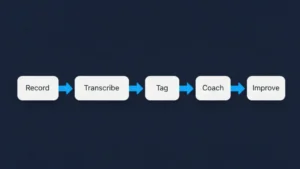
Step E — Rep Reflection:
Ask reps to annotate two wins and one fix on their own transcript before your 1:1. This builds self-awareness and cuts your prep time in half.
Step F — Update the Playbook:
When a pattern proves effective, fold it into scripts, email templates, and call openers. Your playbook becomes a living document.
This transcription-powered coaching loop is how leading teams turn everyday calls into data-driven improvement systems. Learn more about leveraging AI transcription responsibly in sales coaching on Forbes.
3) Building Your Coaching Scorecard (with Transcript Cues)
A light, consistent coaching scorecard is far more effective than a complicated one. It ensures that sales leaders and managers can quickly assess performance, provide actionable feedback, and track improvement over time. The goal isn’t to score perfectly — it’s to drive consistency, confidence, and clarity across your team.
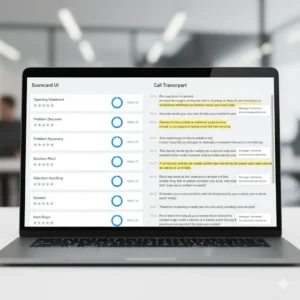
Here’s a practical 10-point framework, where each category can be scored from 0–2, based on observable call behaviors. You can also add timestamp cues from the call transcript to make feedback specific and grounded in reality.
1. Agenda Set (0–2):
Did the rep clearly set expectations at the start of the call? Example: “We’ll confirm fit and outline next steps in 20 minutes. Sound good?” This helps create mutual alignment.
2. Discovery Depth (0–2):
Look for open-ended questions exploring pain, impact, priorities, and budget. Deep discovery reveals buying motivation and urgency.
3. Active Listening (0–2):
Does the rep paraphrase and confirm understanding before responding? Mirroring the prospect’s words builds trust and shows attentiveness.
4. Problem Framing (0–2):
Reps should restate the customer’s problem in their own words to confirm alignment — this anchors the conversation in value.
5. Differentiation Story (0–2):
Did the rep articulate a clear “why us” narrative with proof points, case studies, or success metrics?
6. Objection Handling (0–2):
Apply the ACRC model — Acknowledge, Clarify, Respond, Confirm — for smooth and professional rebuttals.
7. Value Recap (0–2):
Tie features back to measurable outcomes. Example: “This will reduce manual reporting time by 40%.”
8. Next Step (0–2):
Ensure there’s a clear owner, deadline, and follow-up artifact (e.g., proposal, trial, or demo recap).
9. Tone & Pace (0–2):
Evaluate clarity, confidence, and balance in talk-listen ratio — conversational, not robotic.
10. Compliance & Consent (0–2):
Confirm all disclosures are region-appropriate and that data usage is transparent.
A consistent scorecard like this transforms random call reviews into structured coaching that drives measurable sales performance.
Pro tip: For each item, link to 2–3 transcript snippets labeled “gold standard.”
4) Coaching Moments You’ll Find in Every Transcript
Every sales call, no matter the length or outcome, hides a few golden coaching moments — specific points where behavior, tone, or structure directly impacts conversion outcomes. By identifying and analyzing these key moments, you can help your reps turn average calls into top-performing ones. Below are five powerful checkpoints that appear in nearly every transcript.
1. The First 30 Seconds — Setting Context and Control
This is where first impressions are made. Did the rep open with confidence, introduce themselves clearly, and set an agenda? A strong opening might sound like: “Let’s confirm fit and next steps within 20 minutes — does that work for you?” It signals professionalism and direction.
2. The Problem Echo — Mirroring Prospect Pain
When a rep repeats the prospect’s exact phrasing of their pain, it builds trust. For instance, if the buyer says “Our reporting takes forever,” the rep should echo that: “You mentioned reporting takes too long — tell me more about that.” This shows empathy and understanding.
3. The “Why Now” Dig — Revealing Urgency
Many calls fail because reps collect surface facts but never explore timing. Look for moments where the rep asks: “What happens if this problem isn’t solved this quarter?” That’s how urgency and buying triggers emerge.
4. The Pricing Pivot — From Value to Numbers
A great rep doesn’t jump straight into pricing. They first anchor value — ROI, time saved, revenue gained — before mentioning cost. Check how the transition happens; it’s often the difference between hesitation and buy-in.
5. The Closing Minute — Securing Commitment
The last minute should always define next steps: who, when, and what. Example: “Let’s meet Friday at 10 a.m. to review the proposal draft.”
Use transcript search to locate phrases like “budget,” “timeline,” “competitor,” “concerns,” “ROI,” or “pilot.” These are your richest coaching cues — the best places to start improving real performance.
5) How to Roll This Out (Team Playbook)
5.1 Start with 2 calls per rep per week
Coaching density matters more than volume. Two annotated transcripts weekly can transform behavior within a month.
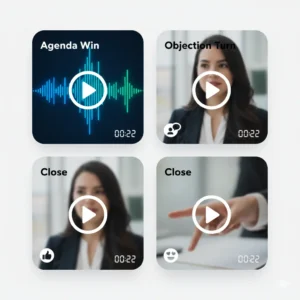
5.2 Normalize “clip culture”
Create a Slack/Teams channel for 30-second wins: best discovery question, tight objection turn, crisp close. Make improvement visible.
5.3 Self-review first, then coach
Ask reps to tag their own wins/gaps. Managers add notes after, not before. This builds autonomous sellers.
5.4 Tie coaching to metrics
Map rubric items to outcomes:
-
Better discovery → higher Stage 2→3 conversion
-
Stronger value recap → fewer discount requests
-
Clear next steps → increased meeting holds and show rates
5.5 Protect time
Put a recurring coaching block on the calendar. Consistency beats intensity.
6) AI That Supercharges Transcripts (Responsibly)
AI is revolutionizing how teams analyze and learn from sales and support calls — but only when used thoughtfully. Instead of just storing transcripts, modern conversation intelligence platforms transform them into actionable insights that improve performance, training, and customer experience. Here’s how AI is reshaping transcript analysis in 2025:
1. Auto-Summaries — Instant Clarity
AI now generates concise one-paragraph executive summaries with bullet-point next steps after every call. This saves hours of manual note-taking and ensures managers or clients can quickly grasp outcomes without replaying recordings.
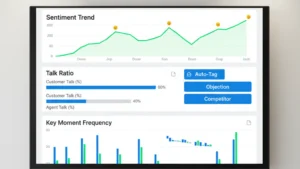
2. Sentiment & Interruption Maps — Visual Insights
Smart AI tools visualize tone, sentiment, and talk ratios to show whether the conversation was balanced or dominated by one side. Spikes in interruptions or objections are flagged, helping reps improve pacing and empathy in future calls.
3. Moment Detection — Precision Coaching
AI automatically identifies critical call moments — like pricing discussions, competitor mentions, or risk signals. These insights make it easy for managers to jump directly to teachable moments without scrubbing through full transcripts.
4. Snippet Generation — Highlight Reels for Training
Instead of reviewing hour-long calls, AI clips 20–40 second highlight reels of key moments (openings, objections, closes). These snippets can be used in onboarding, coaching sessions, or success libraries.
5. Content Lift — Repurpose Great Conversations
The same AI that transcribes can also turn strong responses into FAQ pages, case study one-pagers, or follow-up email templates — turning talk data into marketing and training assets.
Ethics Matter.
Responsible use of AI is essential. Always disclose when recording, comply with regional privacy laws (like GDPR or CCPA), and never use AI to penalize employees. Instead, use it to coach, empower, and elevate human performance — that’s where the true value of AI-powered transcripts lies.
7) Compliance, Consent & Trust
In today’s AI-driven world, trust is the foundation of every recorded conversation. Whether you’re analyzing calls for sales coaching, customer support, or quality assurance, transparency and compliance must come first. Ethical call recording isn’t just about following the law — it’s about building long-term credibility with both customers and your team.
For more on the growing importance of AI ethics in business, see Forbes’ insights on AI and transparency.
1. Notify and Obtain Consent Before Recording
Always start with clear verbal or written consent. A simple statement like “This call may be recorded for training and quality purposes — is that okay?” can protect your business and create transparency. Even when using automated systems, ensure disclaimers are visible and understandable.
2. Follow Regional Rules
Different regions have different consent laws. For example, the U.S. varies by state — some require one-party consent (only one person needs to agree), while others mandate two-party consent (everyone must agree). In Singapore, the UK, and the EU, GDPR and PDPA regulations emphasize explicit consent and data minimization. Always research local compliance standards before implementing call tracking or AI transcription tools.
3. Minimize Sensitive Data
AI transcription tools should automatically redact personally identifiable information (PII) such as credit card details or addresses. Limit who can view full transcripts — sensitive data should be visible only to authorized team members.
4. Set Retention Policies and Access Controls
Define how long call data and transcripts are stored. Many businesses adopt a 90- or 180-day retention policy for non-essential recordings. Use role-based permissions to control access — ensuring only managers or compliance officers can review sensitive material.
5. Treat Transcripts as Coaching IP
Every transcript is a learning asset — your internal coaching intellectual property. Protect it like any other business asset.
When handled responsibly, compliance and trust turn AI-driven conversation intelligence into a competitive advantage, proving that technology and transparency can work hand in hand.
8) Measuring Impact: KPIs to Track
To prove the value of conversation intelligence and call coaching, you need measurable outcomes — key performance indicators (KPIs) that directly link coaching time to business growth. Tracking these metrics ensures that your training efforts translate into real performance gains, not just good intentions.
1. Contact → Meeting Rate (SDRs)
For Sales Development Representatives, this KPI measures how effectively they convert initial outreach into qualified meetings. By analyzing recorded calls, managers can pinpoint what opening lines, tone, or objection-handling techniques produce higher engagement.
2. Stage-to-Stage Conversion (AEs)
Account Executives benefit from tracking how efficiently opportunities move through the sales funnel — from discovery to proposal to close. Reviewing transcripts of each stage reveals where deals stall and what phrasing or follow-up triggers progress.
3. Average Deal Cycle Length
Shorter deal cycles often mean stronger alignment and clearer communication. AI-based conversation insights can highlight bottlenecks or missed cues that prolong decisions, helping teams refine their approach and close faster.
4. Discount Rate / Margin Preservation
By analyzing negotiation segments, leaders can see whether reps rely too heavily on discounts or effectively sell on value. Coaching on objection handling and value framing improves profit margins over time.
5. Win Rate and “No Decision” Percentage
Tracking both closed-won and stalled opportunities provides clarity on the true impact of your coaching. Fewer “no decisions” often indicate better qualification and stronger alignment between prospect needs and your solution.
6. Ramp Time for New Reps
Using AI transcripts, you can compare early performance data with benchmarks, helping new hires reach full productivity faster through targeted coaching.
7. CSAT/NPS for Post-Sale Calls
If you’re coaching Customer Success Managers (CSMs), track satisfaction scores and tone trends. Positive sentiment and quicker resolution times signal real coaching impact.
When you tie these KPIs back to your coaching hours, you’ll quickly demonstrate measurable ROI — showing that conversation intelligence isn’t just data collection, but a driver of consistent business growth.
9) Turning Transcripts into Playbooks
9.1 Discovery libraries
Collect 5 great questions by industry. Each example should include a snippet + transcript line + why it worked.
9.2 Objection handling bank
For each top objection (price, timing, competitor, security), store two model answers with receipts (case study, stat, or story).
9.3 Opening scripts (anti-robot)
Replace generic openers with agenda-based openings that sound human:
“We’re set for 25 minutes to confirm fit and outline next steps. If we both agree it’s not a match, we’ll wrap early. Sound fair?”
9.4 Closing checklist
Embed a mutual action plan step: date, owner, artifact, and success criteria.
10) Common Pitfalls (and Fixes)
-
Pitfall: Managers review too many calls and give general notes.
Fix: Score two calls weekly per rep; give 3 concrete wins, 1 fix with timestamps. -
Pitfall: Coaching becomes negative.
Fix: Lead with strengths; celebrate clips publicly; coach gaps privately. -
Pitfall: No follow-through.
Fix: Book the next coaching review immediately; track behavior changes in the next transcript. -
Pitfall: Reps feel surveilled.
Fix: Involve reps in rubric design; ask them to pick their highlight clip weekly.
11) Templates You Can Steal
11.1 Rep self-review (paste into comments)
-
00:57 — Win: Agenda set clearly; prospect agreed.
-
06:31 — Win: Follow-up question uncovered budget gatekeeper.
-
14:40 — Fix: I answered the security question too quickly; next time ask, “What specific risk worries you?”
11.2 Manager micro-note
-
“Loved 12:10: you summarized the problem in their words — keep this.”
-
“At 19:22, after the pricing question, try: ‘Before numbers, can I check if this outcome would be valuable?’”
11.3 Rubric (light)
-
Agenda | Discovery | Listening | Value | Close | Compliance
(Score 0–2 each; total /12)
12) Coaching Across the Funnel
-
SDR calls: Focus on hook, relevance, and ask. Transcripts reveal where curiosity dies.
-
AE discovery: Hunt for business impact beyond feature fit.
-
Demo calls: Check for story flow and permission checks (“Does this map to what you hoped to see?”).
-
Negotiation: Coach silence, framing, and trading instead of conceding.
-
Renewals/CS: Look for success criteria restated in the customer’s language.
13) Onboarding with Transcripts
New hires ramp faster when you give them:
-
10 gold-standard snippets (agenda, discovery, pricing)
-
Annotated transcripts with comments: what worked and why
-
Shadow library: best/worst calls with scorecards
Challenge them to record their own “gold clip” by week 3.
14) Cross-Team Wins
-
Marketing: Pull voice-of-customer phrases from transcripts for copy, landing pages, and ads.
-
Product: Tag feature requests and UX friction to inform the backlog.
-
Enablement: Convert winning clips into bite-size training modules.
15) FAQs (Quick Answers)
Q1: Do reps need to read every transcript?
No. Use snippets and tags to jump to the 2–3 moments that matter.
Q2: Can AI summaries replace coaching?
No — they accelerate it. Managers still provide context and judgment.
Q3: How do I avoid “robotic” scripts?
Teach principles, not paragraphs. Use transcript examples, then let reps speak naturally.
Q4: What’s a good first goal?
Increase Stage 2→3 conversion by 10% in 60 days using transcript-based coaching.
Q5: Is transcription useful post-sale?
Absolutely — for handoffs, QBRs, and renewals, transcripts improve alignment and retention.
Conclusion: Coach What’s Real, Rep What Works
Calls are where your pipeline becomes revenue. Call transcription turns those moments into coachable assets, accelerates ramp, and scales consistency. Start small: pick two calls per rep each week, use a simple rubric, and coach with timestamped clips. In 30 days you’ll feel the lift; in 90 days you’ll see it in the numbers.
Want more conversation-intelligence playbooks, templates, and real sales examples? Dive into the VoiceTotal Blog — we publish practical guides you can put to work on your very next call.